
A complete sample preliminary loan quote
The sample uses the site's example fix-and-flip: a $300,000 purchase with a $400,000 as-is value, a $100,000 rehab budget and a $550,000 ARV. The program allows 70% As-Is LTV, 90% LTC and 70% LTARV, funds 100% of the rehab, and prices at 12% with 2 points, a $995.00 lender fee and 3 months of minimum interest over a 12-month term.
Sample · illustrative deal · not an offer to lend
Preliminary Loan Quote
Quote Date: Oct 4, 2026
Maple Ave Flip
Deal
- Property
- 418 Maple Ave
- Purchase Price
- $300,000
- As-Is Value
- $400,000
- Rehab Budget
- $100,000
- After-Repair Value (ARV)
- $550,000
Proposed Loan
- Gross Loan Amount
- $280,000.00
- Initial Acquisition Advance
- $180,000.00
- Rehab Holdback
- $100,000.00
- Interest Rate
- 12% annual
- Points
- 2% ($5,600.00)
- Term
- 12 months
- Lender Fee
- $995.00
- Minimum Interest
- 3 months ($8,400.00)
Leverage
- As-Is LTV
- 70%
- LTC
- 70%
- LTARV
- 50.91%
- Binding Constraint
- As-Is LTV
Interest
- Interest Basis
- Full Loan Balance
- Monthly Interest (interest-only)
- $2,800.00
- Scheduled Interest (12 months)
- $33,600.00
Scheduled interest is an estimate for the full stated term; actual interest depends on the payoff date and loan documents.
Estimated Borrower Requirement
- Estimated Cash Required at Closing
- $126,595.00
Purchase price less the initial acquisition advance, plus points, lender fee and interest reserve withheld at closing.
Excludes title, escrow, taxes, insurance, third-party costs, and other closing charges.
The layout follows the app's quote PDF: the deal and the proposed loan on the left; leverage, interest and the borrower's cash on the right; the two disclaimers at the foot. A section only shows lines that apply, so a loan with no interest reserve has no reserve line, and a deal with no ARV has no LTARV line.
What each line on the quote means
Deal
These are the numbers the loan was sized on. Printing them lets the borrower and any broker check every ratio. The as-is value is today's value in current condition; the after-repair value is the estimated value once the rehab is done. If the appraisal changes either one, re-run the numbers and send a new quote instead of editing the old one.
Proposed loan
- Gross Loan Amount ($280,000.00). The full commitment. Here it is the maximum loan, because no smaller requested loan was entered. If a borrower asks for more than the program allows, the quote shows the maximum and adds a note with the requested amount.
- Initial Acquisition Advance ($180,000.00). The part funded at closing toward the purchase: gross loan minus holdback. See acquisition advance.
- Rehab Holdback ($100,000.00). Reserved for rehab draws and not funded at closing. It is the smaller of the funded share of the rehab budget and the loan. See rehab holdback.
- Interest Rate and Term. 12% a year for 12 months, interest-only, with the principal due at maturity.
- Points ($5,600.00). 2% of the gross loan, holdback included. Some lenders word this differently, so the quote prints both the rate and the dollars. See points.
- Lender Fee ($995.00). A flat dollar charge on top of points. See lender fee.
- Minimum Interest. The sample shows 3 months ($8,400.00): monthly interest times the minimum months, on its own line. Minimum interest is not added to scheduled interest, and how it applies at an early payoff is set by the loan documents.
Leverage
The actual ratios of the proposed loan: 70% As-Is LTV, 70% LTC and 50.91% LTARV. The last line names the binding constraint, the limit that produced the lowest cap (As-Is LTV here).
Every ratio is measured on the gross loan, holdback included. A lender that applies its as-is limit to the initial advance alone would quote 45% for the same deal ($180,000 ÷ $400,000). Both conventions exist, so say which one the quote uses. LTV vs LTC vs LTARV covers the other differences.
Interest
The interest basis changes what the rate costs. On a Full Loan Balance basis (often called Dutch interest), interest runs on the whole $280,000 from closing: $2,800.00 a month and $33,600.00 of scheduled interest over 12 months. On a Funded Balance basis (non-Dutch), the quote shows the day count, the initial funded balance and its monthly interest, the maturity date, and total interest estimated from the draw schedule.
Lightning Docs data published by the American Association of Private Lenders (AAPL) in February 2025 shows both in use: of 8,832 bridge construction loans, 28% charged Dutch interest and 72% charged non-Dutch. The Dutch interest calculator shows the dollar gap on a dated draw schedule.
Estimated borrower requirement
Cash to close of $126,595.00 is the $300,000 price less the $180,000 advance, plus $5,600.00 in points and the $995.00 fee (and any interest reserve withheld). Title, escrow, taxes, insurance and other third-party charges are excluded, and the quote says so.
Term sheet vs commitment letter vs loan documents
A quote proposes terms. It does not commit anyone to lend. The documents come in sequence: the quote, then underwriting and approval (sometimes confirmed in a commitment letter), then the loan documents signed at closing. The names vary: the first document may be called a term sheet, a letter of intent or an indication of terms.
| Document | When | What it does |
|---|---|---|
| Preliminary quote or term sheet | Before underwriting | Proposes terms for discussion. The sample says in its own words that it is non-binding and subject to approval. |
| Commitment letter | After underwriting and approval | States the approved terms, the conditions to close and when the offer expires. How far it binds depends on its wording and state law. |
| Loan documents | At closing | The note, the deed of trust or mortgage, the loan agreement, any guaranty and the draw provisions. These set the actual terms. |
Keep the quote's disclaimer intact and don't add promises the documents won't keep. Whether a particular quote or commitment creates obligations is a legal question for your counsel and your state's law, not something a template settles.
Terms lenders often add that the quote doesn't compute
The quote covers sizing, pricing and the borrower's cash at closing. A lender's full term sheet can carry more. None of the items below is calculated by the website or the app, so if your program uses one, add it in your own term sheet and loan documents:
- Extension terms. Whether the borrower can extend the maturity, for how long, at what fee, and under what conditions.
- Exit fee. A charge at payoff, separate from interest. See exit fee.
- Draw and inspection terms. Number of draws, inspection and wire fees, turnaround, and any retainage. For banks, the OCC's Commercial Real Estate Lending handbook (March 2022) says a bank on a progress-payment plan normally holds back 10 to 20 percent of each payment. The calculators treat each draw as the amount actually disbursed.
- Prepayment terms. A prepayment penalty or a minimum interest provision. The quote shows minimum interest as months of interest only; it doesn't compute a payoff shortfall. See minimum interest, exit fees and prepayment.
- Default interest and late charges. The rate after a default and the fee on a late payment.
- Recourse and guaranty. Who guarantees the loan, whether the guaranty is full or limited, and any carve-outs.
- Conditions. Appraisal support for the as-is value and ARV, title, insurance, entity documents, approval of the budget and scope, and how long the quote stays open. The underwriting checklist lists the typical items.
- Third-party costs. Title, escrow, appraisal and recording costs, which the cash figure excludes.
The same quote from the iPhone app
The sample above is an HTML copy of the PDF the app produces. Below is the app's own output for the same deal with no lender fee, which is why its cash figure reads $125,600.00 instead of $126,595.00. The company block holds a fictional lender profile.
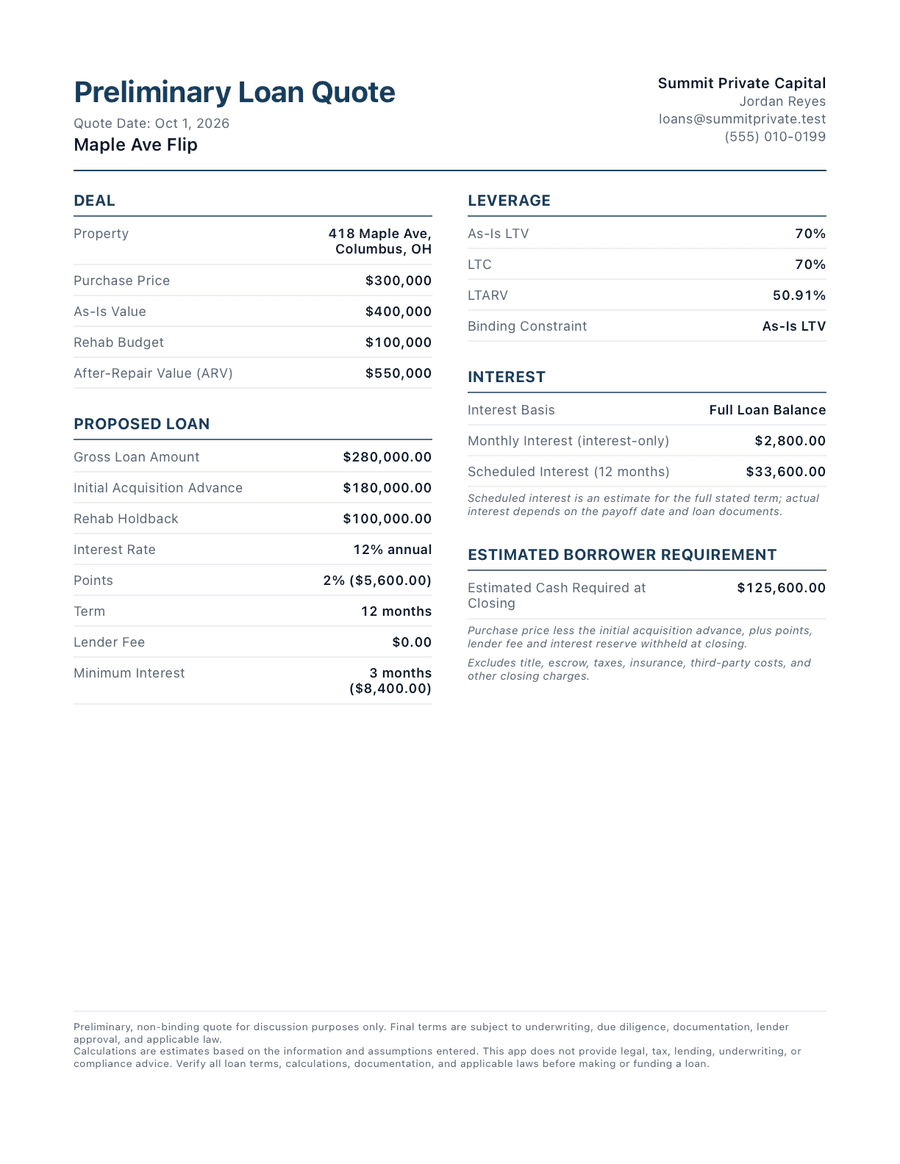
To try the numbers first, the private money loan calculator shows the same points, interest, minimum interest and cash-to-close figures in your browser.
Questions
Is a hard money term sheet binding?
A preliminary quote like the sample is written to be non-binding: it proposes terms for discussion, and final terms are subject to underwriting, due diligence, documentation, lender approval and applicable law. A commitment letter or the loan documents set binding terms. Whether a specific document creates obligations depends on its wording and state law, so have counsel review your forms.
What should a hard money term sheet include?
At minimum: the property and the values the loan was sized on, the gross loan, the initial advance and rehab holdback, the rate, points, lender fees and term, the leverage ratios and which limit binds, how interest is charged, the borrower's estimated cash at closing, and a clear non-binding disclaimer. Lenders may add extension, exit, draw, prepayment, guaranty and condition terms.
Are points charged on the rehab holdback?
In this sample, as in the app and the calculators, points are a percentage of the gross loan, including the holdback. Check how your own program and loan documents define the points base, and print both the percentage and the dollar amount on the quote.
Why is the minimum interest not added to scheduled interest?
Scheduled interest is the estimate for the full term. Minimum interest is a floor that matters only if the loan pays off early. Adding them would double count. The quote shows minimum interest separately as monthly interest times the minimum months.
Does the cash to close include title and escrow?
No. The estimate is the purchase price less the initial advance, plus points, the lender fee and any interest reserve. Title, escrow, taxes, insurance and other third-party charges are excluded and should come from the settlement estimate.
Can I use this template for a bridge loan with no rehab?
Yes. With a zero rehab budget the holdback is zero and the initial advance equals the gross loan. The leverage section shows only the ratios whose values were entered, so a bridge deal with no ARV has no LTARV line.